|
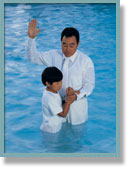 Baptism is a traditional
ordinance and ceremony in many Christian religions with
various symbols and meanings associated with it. Baptism can
be performed in rivers, pools, fonts, and even bath tubs. Some
churches will baptize small children and others will only
baptize adults. Baptism is a traditional
ordinance and ceremony in many Christian religions with
various symbols and meanings associated with it. Baptism can
be performed in rivers, pools, fonts, and even bath tubs. Some
churches will baptize small children and others will only
baptize adults.
The Commission and Blessings of Baptism
Before his ascension into heaven Jesus told his apostles to
teach and baptize all nations (Matthew 29:19-20). Because
baptism is a requirement for membership in the Church of Jesus
Christ, this commission is as strong and applicable today as
it was the day the Lord commanded it.
When we exercise faith in Jesus Christ, repent of our sins,
and are baptized, we are forgiven of our sins through the
Atonement of Christ and can receive the Holy Ghost. This
process is reminiscent of what Paul was told by Ananias
following his dramatic conversion: “Arise, and be baptized,
and wash away thy sins” (Acts 22:16).
Baptism is a gateway through which blessings may flow when an
individual exercises his or her moral agency (free will) to be
baptized. It is after baptism that we are able to receive the
Gift of the Holy Ghost (Moses 6:52).
Baptism shows obedience and a willingness to follow Christ.
When Jesus Christ was baptized he did so “to fulfill all
righteousness” (Matthew 3:15). Jesus was baptized not because
he was in need of forgiveness from his sins, but because he
wanted to set the example for everyone to follow. The narrow
path that Jesus encourages us to follow will lead us to
eternal life in the celestial kingdom—which path is made
possible through the ordinance of baptism.
Baptism and the Misconception of Original Sin
Original sin is a doctrine which assigns the sin of Adam upon
every person born into mortality, and that baptism washes away
this original sin. It is difficult to accept that a loving and
just Father in Heaven would punish any of his children for the
sin of another human being. The fall of Adam created
consequences for us all, but not a sin for which we must be
forgiven through baptism. The Second Article of Faith (AOF)
states: “We believe that men will be punished for their own
sins, and not for Adam’s transgression” (AOF 1:2).
Baptism is an Essential Ordinance
Jesus told Nicodemus “Verily, verily, I say unto thee, Except
a man be born of water and of the spirit, he cannot enter into
the kingdom of God” (John 3:5). Jesus reinforced this doctrine
while visiting the people of the Americas, but in a blunter
and urgent tone: “Whoso believeth in me, and is baptized …
shall inherit the kingdom of God. And whoso believeth not in
me, and is not baptized, shall be
damned” (3 Nephi 11:33–34).
The Method of Baptism
The Bible suggests that baptism was performed by an individual
being completely submerged into the water. Not only does this
suggest the individual being older in age, but it is symbolic
of the death and resurrection of Christ—being buried into the
water to symbolize death, and then being brought back out of
the water to symbolize the resurrection. Put another way, it
is the death of the old person and the resurrection of a born
again person in Jesus Christ (see Romans 6:3-5 and D&C
20:73-74). When compared to a baptism by the sprinkling of
water on one’s head, baptism by immersion provides a fully
scriptural and symbolically rich method of being baptized.
Baptismal Covenants with the Lord
One of the most important aspects of baptism is the covenants
we make with the Lord. Covenants are two-way promises, meaning
we promise to do certain things, and in return the Lord
promises to do certain things. The covenants we make at
baptism include: “[to] come into the fold of God; bear one
another’s burdens; stand as witnesses of God at all times and
in all places; and serve God and keep his commandments.” When
we are baptized and keep the covenants of baptism, the Lord
promises to: “forgive our sins; pour out his Spirit more
abundantly upon us; give us daily guidance and the help of the
Holy Ghost; let us come forth in the First Resurrection; and
give us eternal life” (Gospel Principles, 133-134).
The baptismal covenant is renewed each Sunday with the
partaking of the Sacrament (bread and water). These covenants
are mentioned in the sacrament prayer. See the Sword Series™
paper on the sacrament.
Appropriate Age for Baptism
The scriptures are very clear that we are to repent and be
baptized for the remission of sins. Consider the words of
Peter: “… Repent, and be baptized every one of you in the name
of Jesus Christ for the remission of sins, and ye shall
receive the gift of the Holy Ghost” (Acts 2:38).
The spiritual process that leads to baptism begins with faith;
faith then leads to repentance, and then baptism follows. The
question is at what age can this process really be meaningful?
Can an infant have faith or repent? Most assuredly the answer
is no. So what is that age when accountability and
understanding takes place?
There are varying opinions among the many sects of
Christianity today on what the “age of accountability” is. One
may argue that this differs from child to child, depending on
their intelligence and maturity. To simplify the process, and
since the Bible does not suggest a specific age, the Lord
revealed to the prophet Joseph Smith that the age of
accountability is eight years old, regardless of intelligence
or maturity (D&C 68:25, 27).
Baptism is Performed by Those in Authority
Baptism can only be performed under the authority and
direction of a bishop by those who hold the office of priest
in the Aaronic Priesthood or those holding the Melchizedek
Priesthood. Having two priesthood witnesses present, baptisms
are performed by completely immersing the candidate into the
water (all parts of the body including hair), and then
bringing them out of the water (symbolizing death and
resurrection as mentioned earlier).
Conclusion
The Biblical account of Jesus’ baptism (Matt. 3:13-17)
provides the perfect example for all Christians. The Savior
chose to be baptized to “fulfill all righteousness;” sought
out the individual who held the authority to baptize (John the
Baptist); and was submerged completely in the water by John
the Baptist to complete the baptism. What a wonderful gift
given to us by our Heavenly Father.
Doctrinal
Study: Holy
Ordinances: Baptism
 Download the
Sword Series™ essay on Baptism
Download the
Sword Series™ essay on Baptism |