|
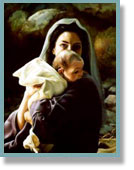 As Christians we all grow up
hearing the story of the Nativity at Christmas time and the
role of Mary in the birth of Jesus. Although the stories of
Mary’s trials and joys are simple, much doctrine has been
generated about her. As Christians we all grow up
hearing the story of the Nativity at Christmas time and the
role of Mary in the birth of Jesus. Although the stories of
Mary’s trials and joys are simple, much doctrine has been
generated about her.
Mary First Referred to in the Garden of Eden
The earliest scriptural reference to Mary can be found in
Genesis, where the Lord speaks to the serpent in the Garden of
Eden: “And I will put enmity between thee and the woman, and
between thy seed and her seed; it shall bruise thy head, and
thou shalt bruise his heel” (Gen. 3:15).
The woman referred to in this scripture is Mary, her seed
being Jesus Christ who would come to bruise the head of the
serpent. Many hundreds of years later, 700 years before the
birth of Christ, Isaiah made reference to Mary saying:
“Behold, a virgin shall conceive, and bear a son, and shall
call his name Immanuel” (Isa. 7:14).
The Calling of Mary
Little is known about Mary’s life before she spoke to the
Angel Gabriel about the coming forth of Christ through her.
The scriptures teach us that Mary was faithful in obeying the
word of God, grateful for the blessings of the Lord, and wise
in receiving counsel from God’s chosen servants.
Mary being mortal, conceived Jesus Christ as a virgin, with
the angel telling her beforehand, “The Holy Ghost shall come
upon thee, and the power of the Highest shall overshadow thee:
therefore also that holy thing which shall be born of thee
shall be called the Son of God” (Luke 1:35). Through this act
God became the literal father of Jesus Christ. Jesus is the
only individual on earth to be born of a mortal Mother and an
immortal Father, making him “the only begotten son of God.”
Ambiguous Christian Doctrines Concerning Mary
Nowhere in the Christian world is Mary more venerated than in
the Catholic Church. Mary is often the symbol of the Catholic
Church in public communications, paintings, and church
buildings. There is the Hail Mary prayer, which is an integral
part of the rosary. Some Catholics have taken their own
personal veneration to the extreme in conducting pilgrimages
to Medjugorje, while having seen appearances of Mary on
buildings, objects, and so forth. It is important to note the
Catholic Church does not promote the worship of Mary.
The Bible does not offer much detail on the life of Mary
before or after the birth of Jesus Christ. Catholic doctrines
about Mary came about long after the ascension of Christ and
not as a result of divine revelation (as the Catholic Church
does not accept revelation after the ascension of Christ); but
rather through councils, debates, and spiritual pondering by
Church leaders and theologians. Consider the following three
doctrines that came as a result of spiritual committees and
not of scriptural origin.
Immaculate Conception
The doctrine of the Immaculate Conception was defined by Pope
Pius IX in what came to be known as the Ineffabilis Deus,
published on December 8, 1854. Pope Sixtus IV from 1483 left
Catholics free to make up their own minds as to whether or not
Mary was subject to original sin or not—this freedom was
verified at the Council of Trent. The doctrine argues that
since Jesus became personified of the Virgin Mary, it was a
requirement that Mary be totally free from sin to bear Christ.
Mary Ever-Virgin
From A.D. 107, under Ignatius of Antioch, to about A.D. 1555
at the Council of Trent, there was constant and spirited
debate on the subject of Mary’s perpetual virginity. It was at
the Council of Trent on August 7, 1555, that the newly elected
Pope Paul IV issued an Ecclesiastical Constitution called "Cum
Quorundam," laying the foundation for the doctrine that Mary
was a virgin before, during, and after the birth of Jesus
Christ.
Mary’s Assumption
The story of Mary’s assumption dates back centuries, but did
not become Catholic Church doctrine until Pope Pius XII in
November of 1950 “dogmatically and infallibly defined” it in
his Apostolic Constitution Munificentissimus Deus.” This led
to the annual celebration of the Feast of the Assumption of
Mary.
All three of these doctrines: the Immaculate Conception, Mary
ever-virgin, and the Assumption; did not originate from the
word of God, but rather through councils and papal
proclamations since the doctrine of divine revelation was has
been rejected by the Catholic Church since its origins. If the
Catholic Church believed in further revelation such
declarations may be more easily accepted. However, Catechism
73 clearly states that there will be no further revelation
after Christ, and therefore these three points of doctrine
concerning Mary must be scrutinized as to their divine origin.
Mary Having Other Children
There are no less than six scriptural references in the Bible
to Mary having other children. These are not scriptures that
merely use the term “brother” in a general sense, but are more
literal. For example Paul writes the following in his letter
to the Galatians: “Then after three years I went up to
Jerusalem to see Peter, and abode with him fifteen days. But
other of the apostles saw I none, save James the Lord’s
brother (Galatians 1:18-19).
Since all of the Apostles were men, and could be considered
the Lord’s brothers, why would James be singled out as “the
Lord’s brother”? Matthew 13:55 and Mark 6:3 further support
that James was a brother of Jesus and that Jesus had brothers
and sisters (plural).
To explain away this Biblical reference, some Catholic
theologians argue that Joseph had a marriage prior to his
union with Mary and had children from that marriage. There is
no historical evidence for this claim. In fact, Pope Boniface
VIII was said to have denied the virginity of Mary following
the birth of Christ.
Perhaps the clearest reference to Mary relinquishing her
virginity after the birth of Christ comes from the gospel of
Matthew which states: “Then Joseph being raised from sleep did
as the angel of the Lord had bidden him, and took unto him his
wife: And knew her not till she had brought forth her
firstborn son: and he called his name JESUS” (Matthew
1:24-25).
The term “knew” is generally associated in the scriptures with
sexual intercourse for the purposes of procreation. For
instance, in Genesis 4 we read that “Adam knew Eve his wife;
and she conceived, and that Cain knew his wife; and she
conceived” (Gen 4:1, 17). Joseph didn’t know Mary until after
Jesus was born, thus the doctrine of the virgin birth stands,
but Mary being ever-virgin does not.
The value and importance the Catholic Church places on
celibacy is well known, and therefore the doctrine of Mary
being ever-virgin is a natural extension of that emphasis. The
doctrines of the Immaculate Conception, Mary being
ever-virgin, and the Assumption, are not central to Mary’s
character and the role she fulfilled as the Mother of Jesus
Christ, therefore they are not critical to the canon.
Conclusion
A true Christian will feel no less reverence towards Mary as a
result of not embracing the three aforementioned doctrines on
Mary. Mary is the mother of our Lord and Savior Jesus Christ;
she is revered, venerated, and said to be a “pattern of
righteousness for all Saints to follow” (Susan Easton Black,
“Mary, His Mother,” Liahona, Dec 1991, 7). Putting Mary into
the proper spiritual perspective will redirect the attention
of the Christian from undue focus on Mary, back to her son
Jesus Christ where it should be.
Doctrinal
Study: Godhead /
Trinity: Mary, Mother of Jesus
 Download the
Sword Series™ essay on Mary, Mother of Jesus
Download the
Sword Series™ essay on Mary, Mother of Jesus |