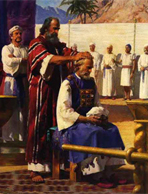
The priesthood of God is the ministering arm for the Lord’s work on earth. There are several Christian churches today with a formal priesthood as part of its ecclesiastical operations. Only two Christian churches claim to have an unbroken apostolic succession as part of their priesthood: the Catholic Church and the Church of Jesus Christ of Latter-day Saints. This section will explore priesthood and the ministry in four parts: 1) structure and authority; 2) healings and blessings; 3) marriage and celibacy; and 4) ministry wages and earnings.

STRUCTURE AND AUTHORITY
God is orderly: Reading the scriptures and patiently observing the natural world brings this comforting assurance into full view. God gives authority to certain men to act in his name. In this way he organizes and administers his Church and avoids the confusion that comes when many claim to have authority from God. Slowly, methodically, this process has proceeded over the millennia, and it has been painstakingly recorded in the Old and New testaments and other sacred texts. The methodology of this structure and authority of the priesthood differs among Christian churches.

Priesthood Definition and Authority
At the most basic level, the priesthood is defined as “the power and authority of God” (Gospel Principles, 81). It was by the power of the priesthood that the heavens and earth were created and the universe is maintained in its perfect order. Through the power of the priesthood, the Lord achieves his ultimate mission “to bring to pass the immortality and eternal life of man” (Moses 1:39).

There was a priesthood of God before, during, and after the ministry of Jesus Christ. When Christ was upon the earth, he ordained Apostles to lead his Church and “gave them the power and authority of the priesthood to act in his name” (Mark 3:13-15; John 15:16; Gospel Principles 82).

Priesthood authority from God is required to perform the ordinances such as baptism, confirmation, the blessing and passing of the sacrament, administering to the sick, performing special blessings, and the administration of temple ordinances.

Priesthood Structure
It would be difficult to outline the structure of the priesthood in every Christian Church today. Instead we have elected to present the structure of the priesthood as it exists in the Church of Jesus Christ of Latter-day Saints, which most closely resembles that which has been outlined in the scriptures, most notably the Bible. The priesthood is divided into the Aaronic Priesthood (the lesser priesthood) and the Melchizedek Priesthood (the greater priesthood). The Aaronic Priesthood is sometimes referred to as the “preparatory priesthood.”

Aaronic Priesthood
The Aaronic Priesthood originated in the time of Moses and was conferred upon Aaron and his sons to administer in the ecclesiastical duties of God (Num. 18:1). Today, Aaronic Priesthood holders administer the outward ordinances of repentance and baptism (D&C 107:13–14, D&C 107:20).

The offices within the Aaronic Priesthood today include deacon, teacher, priest, and bishop. Within a local church (or ward), the Aaronic Priesthood is organized into a deacon’s quorum, a teacher’s quorum, and a priest quorum.

Deacon: Deacons perform duties such as passing the sacrament, ushering during Sunday services or special occasions, helping to maintain and clean Church buildings and grounds, assisting priesthood leaders, and fulfilling special Church assignments such as the collection of fast offerings.

Teacher: In addition to the duties of a deacon, teachers take an active role in helping Church members live the commandments, including home teaching. Teachers are also tasked with the preparation of the bread and water for the sacrament.

Priest: In addition to the duties of a deacon and teacher, priests may baptize members, bless the bread and water of the sacrament, and actively preach the gospel. A priest, in preparation for the Melchizedek Priesthood, may ordain deacons, teachers, and other priests. If there are no Melchizedek Priesthood holders available, a priest may officiate at Church meetings.

Bishop: A bishop holds the Melchizedek Priesthood in the office of a high priest and presides over the Aaronic Priesthood within the ward he is assigned—specifically as the president of the priest’s quorum. The bishop is the leader and presides over the entire ward and is responsible for the spiritual well-being of every individual who lives within the geographic boundaries of his ward—regardless of their religious affiliation. Bishops are given the gift of discernment in order to act in their stewardship as the Common Judge in Israel.

Melchizedek Priesthood
Melchizedek Priesthood holders are given the power and authority to lead the spiritual work of the church, including the preaching of the gospel and the administration of the ordinances within temples. The President of the Church of Jesus Christ of Latter-day Saints is the presiding high priest over the world-wide Melchizedek Priesthood.

The offices within the Melchizedek Priesthood include elder, high priest, patriarch, seventy, and apostle. Within a ward, the Melchizedek Priesthood is organized into an elders quorum and a high priest group. The high priest group is part of a stake-wide high priest quorum presided over by the stake president.

Elder: Each Melchizedek Priesthood holder can be referred to as an elder, with all elders being called to “teach, expound, exhort, baptize, and watch over the Church” (Gospel Principles, 90). Elders can lead or participate in the ordinance of confirmation in which the gift of the Holy Ghost is bestowed by laying on of hands. Elders can administer to the sick, bless children of record, and preside at Church meetings as appropriate in the absence of a high priest.

High Priest: A high priest is a Melchizedek Priesthood holder who is put in charge of the spiritual affairs of a particular entity or geographic area. Members of bishoprics, stake presidencies, mission presidencies, high councilors, and other selected leaders of the church must be ordained high priests. A high priest retains all of the spiritual privileges of an elder.

Patriarch: A patriarch is called to give special blessings to the Church. “Patriarchal blessings” provide guidance and insight to those who receive them. See Genesis 49 where Jacob gave his sons blessings that closely resemble that of modern day patriarchal blessings.

Seventy: Seventies are General Authorities of the Church who are called as “special witnesses” of Jesus Christ to the entire world and help administer in the affairs of the Church. There are several quorums of seventies that currently serve within the Church of Jesus Christ of Latter-day Saints.

Apostle: Like the seventies, apostles are also special witnesses of Jesus Christ to the world and administer in the affairs of the Church as prophets, seers, and revelators. There are twelve apostles and together they form the Quorum of the Twelve Apostles; however, members of the first presidency may also be set apart as members of the Quorum of the Twelve Apostles. Apostles are given all of the keys of the kingdom of God on earth, but only the President of the Church “actively exercises all of the keys…the others act under his direction” (Gospel Principles, 91).

Priesthood Qualifications
One will find varying degrees of academic qualifications required to exercise the priesthood in various Christian Churches. For instance, there are substantial academic requirements to hold the priesthood in the Catholic Church (undergraduate and graduate studies), but no such academic requirements for the priesthood in the Church of Jesus Christ of Latter-day Saints.

With respect to professional qualifications for the priesthood we are reminded of the admonition of Paul to the Corinthians that “God hath chosen the foolish things of the world to confound the wise; and God hath chosen the weak things of the world to confound the things which are mighty” (1 Cor. 1:27). In this letter to Timothy Paul clearly details the requirements for a bishop: “A bishop then must be blameless, the husband of one wife, vigilant, sober, of good behavior, given to hospitality, apt to teach; Not given to wine, no striker; not greedy of filthy lucre; but patient, not a brawler, not covetous. One that ruleth well in his own house, having his children in subjection with all gravity. (For if a man know not how to rule his own house, how shall he take care of the church of God?)…” (1 Timothy 3:2-5).

A true Christian priesthood holder must be a “worthy male” and receive the priesthood from those with authority to grant it. This simplicity is in line with what was intended in the scriptures, providing spiritual and practical application. Although education can greatly enhance a person’s ability to minister, having the companionship of the Holy Ghost is far more valuable than having an academic degree.

In the Church of Jesus Christ of Latter-day Saints the priesthood is available to all worthy male members of the Church. It is granted “by the laying on of hands by those who are in authority, to preach the Gospel and administer in the ordinances thereof” (Articles of Faith 1:5). There are no academic or professional requirements to hold the priesthood. However, readiness for any leadership calling takes into account reliable evidence of such readiness, and this evidence can include educational and professional achievements.

Conclusion
The priesthood is the power of God on earth given to those who are worthy and willing to minister to the children of God. The division of the priesthoods into two parts, the Aaronic and the Melchizedek, is a wise and correct organization of these powers. Although it is clear that Jesus fulfilled the Law of Moses, he did not do away with everything under the Law of Moses—such as the 10 commandments. However, since perfection cannot be obtained through the Aaronic Priesthood alone (Heb 7:11-12), there is a need for the Melchizedek Priesthood in combination with the Aaronic Priesthood.


PRIESTHOOD POWER – HEALINGS AND BLESSINGS
The priesthood of Jesus Christ has power from God for the blessing of his children on earth. Certainly such power includes the power to heal and bless. Otherwise the priesthood is merely ceremonial, and not the power of God on earth.

The Power and Faith to Heal and Bless
Christian doctrine on healing operates under the premise that healing comes as a result of faith. Therefore, administering to the sick is always preceded by a request for the blessing by the person in need or an individual close to that person (parent, sibling, or other). In doing so the healing comes as an answer to exercised faith (Matt. 8:5-15).

As the power of God on earth, the priesthood has the authority and power to heal and bless the faithful. While those who hold the Melchizedek Priesthood are given the power to anoint the sick and perform blessings, there are some priesthood holders who are given the gift of healing the sick, which is a gift of the spirit. In all cases, holders of the priesthood are urged to use their priesthood “by persuasion, by long-suffering, by gentleness and meekness, and by love unfeigned” (D&C 121:41).

Types of Priesthood Blessings
The power to bless can come in the form of anointing the sick (in whatever state they may be) or to provide a blessing of guidance and comfort to an individual. The individual need not be gravely ill, but they must have faith that the Lord Jesus Christ (or a parent/individual acting on faith in their behalf), acting through the priesthood, will heal them of their infirmity. Among the ordinances that include blessings that can take place through the priesthood are blessings of children; of comfort and/or guidance; and of healing. There are blessings that take place during the ordinance of confirmation, and those that take place when individuals are set apart in callings. There are also patriarchal blessings that provide guidance and encouragement, blessings of homes, and dedication of graves.

Performing the Ordinance of Blessings
Priesthood blessings for healing typically begin with one priesthood holder anointing the head of the afflicted with consecrated oil (Oil is consecrated by Melchizedek Priesthood holders in a separate ordinance). After the anointing with oil, the priesthood holder who anointed places his hands on the head of the afflicted, calls the person by his or her full name, states the authority of the priesthood, recites a simple prayer regarding the anointing, and closes in the name of Jesus Christ. This is all done audibly, not in silence.

A second Melchizedek Priesthood holder then places his hands with those of the first on the person’s head and seals the anointing: He pronounces a blessing as dictated by the Holy Ghost, and then closes in the name of Jesus Christ. This too is done audibly. In an emergency, a single Melchizedek Priesthood holder can both anoint and seal.

A blessing of comfort is performed by a Melchizedek Priesthood holder laying his hands upon the head of the desiring individual, calling the person by his or her full name, stating the authority of the priesthood, providing a blessing as dictated by the Holy Ghost, and then closing in the name of Jesus Christ.

A priesthood holder should be in a state of worthiness when performing a blessing, performing each blessing in a reverent and dignified manner, realizing at all times that he is acting on behalf of the Savior Jesus Christ. In some cases a group of Melchizedek priesthood holders may perform the blessing. This is typically done with each priesthood holder having his left hand on the head of the individual being blessed and his right hand on the shoulder of the priesthood holder next to him, all forming a circle around the individual.

Conclusion
John 14:12 which states: “Verily, verily, I say unto you, He that believeth on me, the works that I do shall he do also; and greater works than these shall he do.…” Through the priesthood of God these great works can truly come to pass. The belief that the power of God can be exercised by men to do miracles, healings, and blessings of all kinds is certainly not widespread among the Christian community, but where it is these marvelous things can happen.

The discovery of the power of the priesthood can make a profound difference in the lives of a family, a church, a community, a nation, and even the entire world. Christ meant for us to do great things in his name. Why not then exercise a priesthood that actually puts that promise into action to bless the lives of the children of God?


PRIESTHOOD MARRIAGE AND CELIBACY
While the Catholic Church maintains a celibate priesthood, nearly all other priesthood bearing Christian religions allow priesthood holders to marry. There is significant debate and consternation among Catholics about marriage in the priesthood.

The History of the Celibate Priesthood
For centuries after the ascension of Christ, historical records indicate that priests, bishops and as many as 39 popes were married (Kelly, J. N. D. Oxford Dictionary of Popes. New York, Oxford Press. 1986). In A.D. 325, at the Council of Nicaea, a proclamation was put forth that outlined that after their ordination a priest was not allowed to marry. It is reported that about 60 years later, around A.D. 385, Siricius severed relations with his wife in order to position himself to become pope (Padovano, A. Power, Sex, and Church Structures. A lecture presented at Call To Action, Chicago. 1994). As pope he decreed that priests could no longer have sexual relations with their wives, moving one step closer to the celibate priesthood.

Although not substantiated, some hypothesize that the celibate priesthood came about due to issues of property in the Church. In the early church, if a priest died there were apparently questions as to whom the property of the priest belonged—the wife of the deceased priest, or the church.

Eusebius, a scholar born in A.D. 260, who was made Bishop of Caesarea in 314, provided valuable insights into the marriages of the apostles and his concerns on the subject of celibacy in the Catholic Church. Eusebius was not in favor of a celibate priesthood and stated his concerns freely in several letters and writings.

Proponents of a married priesthood generally point immediately to the fact that Peter and several of the apostles were married men, and this tradition continued into the second and third century when, it is widely believed, most priests in the Catholic Church were married. It was around this same that Gnosticism put forward the unfounded assertion that marriage had a negative impact on the lives of men and women alike.

One can see from this brief history that celibacy in the Catholic Church evolved over time. The apostle Bruce R. McConkie infers that the requirement of celibacy is a part of the great apostasy, being contrary to such scriptures as Hebrews 13:4, Genesis 1:28, and 1 Timothy 4:1-3. McConkie explains that many have used the writings of Paul to support the doctrine of celibacy, but that such justifications are distorted (Mormon Doctrine, 118-119).

The Celibate Priesthood Limits Vocations
In the book, Full Pews and Empty Altars: Demographics of the Priest Shortage in United States Catholic Diocese, the authors state that by the year 2005, the U.S. will have experienced a 40% decrease in the total number of priests from 1965 levels, while at the same time experiencing a 65% increase in the number of Catholics (Schoenherr and Young: Full Pews, Empty Altars, 1993; University of Wisconsin Press). If these projections are correct, the doctrine of a celibate priesthood could be one of the main reasons for this unfortunate lack of priests.

Conclusion
Much has been written about celibacy in the Catholic Church. Many faithful members of the Catholic faith argue that allowing priests to marry would help the Church to prosper in a multitude of ways. When one studies the history of celibacy and associated aberrations in the Catholic Church, one can begin to understand how a practice became a doctrine and found its way into the Catechism—despite scriptural evidence to the contrary.

The scriptural and historical support for a married priesthood is overwhelming. Furthermore, common spiritual sense about the role God gave to man mortality suggests that celibacy, although a noble intention in showing commitment and sacrifice to the Lord, is incompatible with the nature God gave man. Consider the scripture from Genesis 2:18: “It is not good that the man should be alone; I will make him an help meet for him.”

Both married and unmarried men should be permitted to hold the priesthood. Like all members of the Church, priesthood holders must live the law of chastity, which states: “We are to have sexual relations only with our spouse to whom we are legally married. No one, male or female, is to have sexual relations before marriage. After marriage, sexual relations are permitted only with a spouse” (Gospel Principles, 249).


MINISTRY WAGES AND EARNINGS
Should a priesthood holder or any minister be paid for his services to a community or congregation? This question can evoke a wide variety of emotions among members and clergy of various Christian sects. There are scriptural references that suggest the answer is no, while there are a few scriptures that imply a limited form of living compensation is acceptable.

The Scriptures Discourage a Paid Ministry
There are several passages in the Bible that warn against a paid ministry, or clearly indicate the need to avoid compensation for religious service. In 1 Peter 5:2, Peter admonishes the priesthood to “Feed the flock of God which is among you, taking the oversight thereof, not by constraint, but willingly; not for filthy lucre, but of a ready mind.” Jesus confirmed this principle when he said “...freely ye have received, freely give” (Matthew 10:8). Other such scriptures can be found in Luke 10:4, John 10:12, 1 Thes. 2:9, 2 Thes. 3:8, Titus 1:6,11, and Acts 20:33.

We once again turn to the Church of Jesus Christ of Latter-day Saints as an example of Bible-based Christian practices, this time having to do with the unpaid ministry. Boyd K Packer of the Quorum of the Twelve Apostles had this to say about a lay clergy and operation that operates without any form of compensation: “In the Church of Jesus Christ of Latter-day Saints there is no paid ministry, no professional clergy, as is common in other churches. More significant even than this is that there is no laity, no lay membership as such; men are eligible to hold the priesthood and to carry on the ministry of the Church, and both men and women serve in many auxiliary capacities. This responsibility comes to men whether they are rich or poor, and with this responsibility also comes the authority. There are many who would deny, and others who would disregard it; nevertheless, the measure of that authority does not depend on whether men sustain that authority, but rather depends on whether God will recognize and honor that authority.” (Boyd K. Packer, “Follow the Brethren,” Tambuli, Sept. 1979, 53)

Derek A. Cuthbert of the Seventy wrote: “Over the years of my membership in The Church of Jesus Christ of Latter-day Saints, I have greatly appreciated the opportunities for service, for there is no paid ministry. Every worthy male member of the Church above the age of twelve may hold an office in the priesthood. Similarly, the girls and women of the Church receive many assignments to lead and teach and serve. Each family is visited monthly by priesthood home teachers, who care for their needs, and by visiting teachers from the women’s Relief Society, whose motto is ‘charity never faileth’” (Elder Derek A. Cuthbert, “What’s the Difference?” Ensign, Nov. 1985, 24).

There are volunteer opportunities in nearly all Christian churches today, but a very few that operate without some form of paid ministry. The key to avoiding the issues that a paid ministry can cause is to structure the church in such a way that the ministry is spread among many. By spreading the work among many, the church can avoid the need for one (or a few) to shoulder the bulk of the load for ministry and administration, resulting in the need for salaries to be paid.

Conclusion
The best way to get Christians involved in the building of the Kingdom of God on earth is to give them something meaningful to do in service. Service can be motivated by a sense of duty, but is always best done out of the love of God and a charitable heart. Motivation should never come as a result of financial compensation.

Without requiring stringent academic requirements for the priesthood or compensation of any kind, relying completely on the inspiration of the Lord and the faith of Church members, the ministry of Jesus Christ changes lives, grows, and is astonishingly effective. One can’t help but think that this is exactly the way the early church operated, where men such as the apostles had to earn a living while fulfilling their ecclesiastical duties. If there was support rendered, it was merely that which sustained life and nothing more.

Doctrinal Study: The Lord's Church: Priesthood and Ministry

  Download the Sword Series™ essay on Priesthood and Ministry

Home   |   About   |   Study Forum   |   Christian Defined   |   Sword Series (TM)   |   Store   |  Scriptures

Editorial Corner:    Columns  |  Blogs   |   Apologetics   |   Videos

Sitemap | Privacy | Contact | Site Designed By: BoldMultimedia.com

© 2008. Foundation for Christian Studies. All Rights Reserved.